Sunday, March 28, 2010

“Deep Inside Clint Star,” Clint Alberta, 2000


The title of the film by Clint Alberta speaks two-fold; not only is Alberta making his own pornographic film, but he’s also granting the audience permission into internal conversations and conflicts within himself and his subjects.  Aside from being of the Canadian persuasion, they call have several things in common: they are Native American, sexuality issues and identity issues.

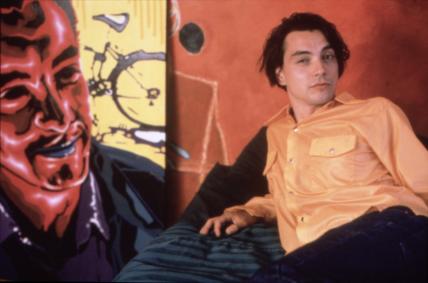
Clint Alberta, born as Clint David Morrill and also credited in his films under the surname Torangeau, was known as a filmmaker for his quirky-nouveau approach to making documentaries.   For example, Alberta had his cameramen use several cameras of varying quality because he believed that the grittiness of it could help his fellow Natives feel as though it was made by one of their own.  He also made painstaking efforts ensure that any technical problems, such as camera focusing issues, visible booms and microphones, and even several verbal altercations with crewmembers over how he wanted to be portrayed in a shot, were captured in the film.   Alberta may have been using his massive ego to try to emphasize his thesis of the crisis of identity among modern Natives, but it more often played off as making him look like an insecure, amateur director.   His unique choices were obviously successful; the film, financed by the National Film Board of Canada, was shown in 2000 at both the Vancouver and Sundance Film Festivals.


Alberta’s film, which is just as ethnographic and introspective as it is kooky and innovating, aims to drive home the struggles of being “native” in Canada by presenting the film as a cheaply made porno starring his alter-ego Clint Star.  Alberta allows this imaginary film to grant him artistic license to add sexually evocative music, cheesy intertitles and haphazard video edits.  He also uses this “deep inside” theme as a synthesis for the honest conversations he engages in with his subjects.  In this fantasy context, Alberta introduces nearly all his characters in sexually suggestive situations: sleazy hotel rooms, at a café, and lying on a picnic blanket in a park.  His efforts at making a seriously film about serious issues are downplayed in this forum until he starts talking to his subjects outdoors.   His presence in his interviews, with subjects and himself, are comical and amateurish – especially the one involving Tawny Maine where they are sitting on a park bench talking about her personal history.  Instead of engaging with her in a sincere conversation about her past as a native adopted into a white family, Alberta stares off into the distance, his face and body stone cold as though posing for a long exposure.  Unfortunately his vanity distracts from the overall tone of the piece, which continues on from this point wavering between deeply intellectual and borderline childish.

Despite its flaws, “Deep Inside Clint Star” manages to create an open dialogue about the troubles Canadian natives have with adjusting to modern society.  Alberta’s subjects talk liberally about suicide, sexual abuse, self-loathing, child molestation, sexual identity, death, physical abuse, racism and drug and alcohol problems that plagued their lives and those that surround them.  With his subjects facing the same set of problems, Alberta asks the audience to take this knowledge and try to determine why, after “500 years of oppression,” natives are still the victims of imperialist standards.  

---

(And on a lighter note, I was frequently distracted throughout the film by the all subjects’ teeth.  No offense to Clint (R.I.P.), Becky, Tawny, his mom and the boys, but this is Canada – the premiere standard of socialized medicine that has been frequently used as positive PR for the free-medicine-for-all movement in the U.S. for the past two decades. Just sayin’.)

Tuesday, March 16, 2010

“August: A Moment Before the Eruption,” Avi Mograbi, 2002


Avi Mograbi is an interesting character.  Known as a filmmaker for his innovative techniques, “August: A Moment Before the Eruption” is truly a unique film about Israeli people and their reaction to conflict.  Shot over the course of a month, Mograbi’s pseudodocumentary shifts between self-indulgent YouTube-style commentary, auditions for a failed film project, images of men, women and children on the street, and news clips.  His end product provides a global conversation on the lack of cooperation between divided parties and how the people in this region thrive on conflict.

The Middle East is a troubled place.  The conflict between Israel and Palestine seems never ending and becomes more hostile and deadly as each year passes. Media coverage relishes on violent marches and daily protests.  In August, above any other month, terrible things happen at every turn.  Mograbi, just like his camera, puts on an act as an independent enemy: a menace and instigator of trouble on the streets of Tel Aviv.  

The filmmaker expresses his discontent with the content of his own documentary through the musings of his wife, whom he pretends to be by wearing a towel on his head.  “Terrible things happen at every turn,” she says, “but you can’t seem to film them.”  A great deal of the film becomes Mograbi filming normal people doing normal things.  While she may have been correct, what he pastes together from his interactions with Israelis is just as effective, if not more, as footage of actual violence.

The word “August,” as the film progresses, begins to take on new meanings.  August, as Mograbi says early on, is “cruel,” “unnecessary” and “leads to nowhere.”  The month of August becomes symbolic with the irrepressible discontent and misappropriated hate that fills the people of Israel.  At first, people are only curious is Mograbi is a journalist.  They ask him why he finds it necessary to stand on a street corner and shoot images of people talking and engaging in average daily functions.  They tell him he can’t film and start aggravating Mograbi, whose counter attacks only further prove that tension is inescapable.

Mograbi uses his fictionalized tiff between his business partner and wife as another example of the elevated tensions in August.  The two characters bicker over Mograbi’s documentary – she thinks it’s a foolish decision because she finds the month to be delightful and can’t understand why he is so highly critical of his own people.  His business partner Ronny, on the other hand, doesn’t understand why Mograbi is working on the doc instead of the film about the Hebron massacre of 1994 that they’re putting together. Through her confrontation with his business partner, his wife begins to understand why Mograbi can’t find anything good to say about August.


Mograbi’s off-beat sense of humor goes to extreme of saying that the citizens of Israel enjoy sexual gratification from their heightened state of anger and hate.  His split-screen madness escalates on a parallel timeline with his man-on-the-street interviews, climaxing as Mograbi begins to fight with people and his wife and Ronny’s shouting match turns sexual. The title of the film takes on a more apparent meaning as his wife is literally penetrated with anger and as she and Ronny exclaim moans of joy and frustration, the film abruptly ends, leaving the audience in as much of an aggravated state as the subjects of his film.


Sunday, March 7, 2010

“The Good Woman of Bangkok,” Dennis O’Rourke, 1992


Before writing this article, I did a search on the internet for background information on Dennis O’Rourke, the maker of the film we watched in class this week, “The Good Woman of Bangkok,” and stumbled upon this quote by Michael Wilmington of the Los Angeles Times: “The film itself is an act of love: its ardor, evasions, hypocrisies, idealism, its unhealable wounds... nakedly open, non-exploitive and truly harrowing... a great film.” 

Wilmington’s critique as a commercial film is completely understandable.  On the surface, the film appears to be an open window into the Thai prostitution circuit.  O’Rourke brings his camera into the go-go dance clubs and shows us the faces of unhappy women forced to dance topless and even perform lewd acts on stage.  Paired with Opera music, we find these images of false love to be tragic and disgusting.  In a separate article, Wilmington goes on to assert that “those who denounce this movie for its displays of nudity or conversations about sex will have foolishly missed the point.”

But as far as approaching the film from an academic standpoint, Wilmington couldn’t be more wrong.  O’Rourke throws objectivity out the window, creating a mildly scientific film that is a heavily dramatized, idealistic disapproval of the Asian sex industry as a whole.  Aoi’s statements on the complicated life of a sex worker are as contrived as they were depressing.  Her constant cries of “I hate men” and “I hate sex” were only amplified by the conversations with the despicable and disillusioned white western clients, which O’Rourke was able to procure because he could so easily identify with them (not so much despicable, but just as disillusioned).


O’Rourke, at the time just reeling from a nasty divorce, decides to travel to Thailand, like many men, to seek the comfort of a Thai prostitute.  What makes the women of Bangkok so desirable is the blasé approach the city has to the sex trade and the eagerness at which they aim to please foreigners.  O’Rourke meets Aoi, a 25-year-old prostitute and divorced mother of two who has come from a neighboring rural town to make money to support her family.  He finds disappointment, heartache and frustration in her tale and chooses to keep her on as a paid companion for the duration of his filmmaking.  In return for access to her life story, and the ability to film her daily functions such as riding taxis to meet clients and who knows what else, he promises her a rice farm so that she can make a new life for herself.  Unfortunately, O’Rourke makes a mistake that no Anthropologist should ever commit – he failed to understand that most Thai people believe that one’s job, one’s family situation and/or one’s social position is final and cannot be changed; and also that a divorced woman – or worse, a prostitute – is tainted and can never live a normal life.  So while his gesture seems genuine, it didn’t surprise me when he revealed at the end of the film (spoiler alert!) that Aoi did not accept his gift and continued to work as a prostitute.  

At this point, he makes another grave mistake for a scientific, objective observer: he passes judgment on a woman who, with this understanding of Thai culture, has fully accepted her terrible fate.  O’Rourke doesn’t just offer to the audience that she refused to live on the farm and instead chooses return to her life as a sex worker – he says that she works at a “sleazy” dance club in the city.  His micro-investment fails and his efforts to hammer home the demoralization of Thai society instead makes O’Rourke look like a scorned lover who finds his selfish efforts at rehabilitating a broken woman unsuccessful.  Though he warned us at the beginning of the film of his involvement with Aoi, O’Rourke’s subjectivity became more suspect with this statement.


Sunday, February 28, 2010

"Forest of Bliss," Robert Gardner, 1986


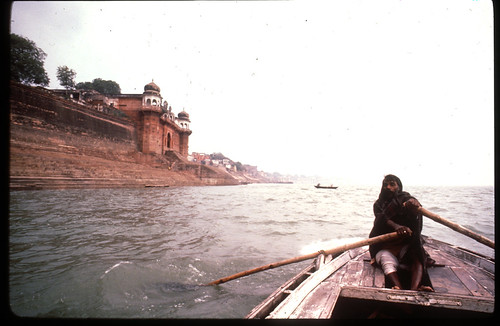
Robert Garner is no ordinary ethnographic documentarian.  Caught somewhere between artist and scientist, the filmmaker’s career highlights include such academic triumphs as a tenured teaching position at Harvard.  His true talent lies in capturing the visual essence of his subjects, creating works are as visually inspirational as well as intellectual stimulation, and he has often said that poetry is the most effective way to tell a story and his objective as a filmmaker is to make everyone in his audience an anthropologist.  His 1986 film “Forest of Bliss” about the death rituals in the Indian town of Benares is creative and modern yet completely functional as a scientific film, playing like a travelogue of the city, but only of the moments Gardner felt were relevant to the film.

Gardner chose not to narrate the film simply because he had learned over the years that it provided no benefit to his work.  Left to interpret the wails and chants of the people of Benares, the audience is forced to engage in scientific reasoning to really find out what is transpiring on the screen. We have shots of everyday life and then of people experiencing joy.  We see images of a city with deep religious roots contrasted with the fresh youth of today. Children fly kites and play games in the street.  And woven between these moments of normalcy we watch the dead parade through the streets.  Gardner shocks the audience by opening with a vicious dog fight – much less about pride but more to the degree of avoiding starvation.  Everything about this town centers around death.   It seems as though Gardner chose to contrast these two images only to romanticize the morbid rituals of the people of Benares.


At dawn we follow a man from his home through a maze of stairwells and alleyways to the river for his morning bath.  Another point in the film we see children flying kites at the bank and dogs drinking water from the edge.  Not until later do we see that this is the same body of water that the dead bodies are transported on and disposed of.  Gardner continues to emphasize throughout the film the degree of normalcy to which the people of Benares treat the entire process of death by making their daily functions seem rote and the people not even phased by the funeral processions. 

The film opens up at sunrise and ends at sunset.  To say that all the footage that was incorporated in the film took place in a single day is impossible and would greatly falsify Gardner’s observations. Without scientific debate, I would only have thought that this film was meant to bring to like the fact that the people of Benares only do four things: walk stairs, care for the dead, build things, and ring bells and chant.  Instead we learn that the holy city of Benares is a place that people go to die simply for its death rituals.  We do not see more than a few glimpses of mourning, as the film chooses to focus on their unique disposal of the dead.  The body is first bound in cloth and then placed on hand-made wooden gurneys.  At this point the body is dressed in fabric and chants (what we assume must be prayers) are spoken while the area is cleansed and body begins its journey through the town to the shore to be burned.  And many bells are rung.


Sunday, February 14, 2010

"Them and Me," Stéphane Breton, 2001


Anthropologists are observers:  we stand apart from our subjects as we take copious notes that are subsequently used to help us create a scientific body of work (put that on Wikipedia!).  We look to others as sources for our theories and published works.  But what happens when we consider the fact that our presence can impact our study?  French filmmaker and anthropologist Stéphane Breton tackles this exact predicament in his 2001 film “Eux Et Moi” (“Them and Me”): exploring the lives of Papua New Guinea natives through the eyes of an anthropologist.  

I recommend this film highly to anyone considering an entry into the social sciences.  Breton’s film acts as a how-to-guide for students and novices unsure of how they will be accepted in the field.  While still offering insight into the daily exchanges of the villagers, he spends the majority of the film in reflection, inviting the viewer along for the ride as he tries to figure out how to most effectively play the role of an ethnographer.  

Breton’s highly personalized approach, albeit unconventional, still effectively manages to share the ethnographers journey while providing commentary on cultural topics such as spirituality, age relations, work ethic, diet, gender roles, money systems and westernization. In fact, in his portrayal, the highlands of Irian Jaya (nestled in the lush outback of Papua New Guinea), seem almost impervious to social change.   Breton at first appears to be just another white man in a string of foreign visitors that have been trying to influence islanders for centuries.  Soon we see that Breton, having learned the local language by trial and error during previous visits, has successfully managed to break down the wall between subject and scientist, his efforts of integration exemplified by the fact that the villagers have allowed him to build a home of his own on the outskirts of town. 

We join Breton on this occasion as he returns with the objective of acquiring enough funds for his adopted son’s bride price.  His “son” (whose name I do not remember) was one of the first visitors to accept Breton, helping him learn the language though he does not speak French, and is one of his closest confidants in the village.  We see them engaging throughout the film in a playful manner, mocking each other’s looks and customs and freely using coarse language.  Though they have an understanding of Western money and accept Indonesian paper bills from Breton, the natives still employ ornately decorated shells as currency.   In fact, we see on several occasions that despite understanding the numeral worth of each bill, the natives prefer to have a larger quantity of bills, just as they would of shells. 


Breton’s memoir-esque approach managed to engage me emotionally and intellectually by showcasing his encounters with natives  in a manner that I as a student could easily understand.  I spent my time watching the film enthralled with a culture that has been able to remain pure and “primitive” (by Western standards) and at the same time eager to discover how Breton conducted his fieldwork.  While my teachers have always taught us to follow the “fly-by-the-seat-of-your-pants” method, the film offers something that I’ve never before been able to comprehend – the fact that even successful filmmakers have to take this approach. 

Sunday, February 7, 2010

"A Joking Relationship," John Marshall, 1962


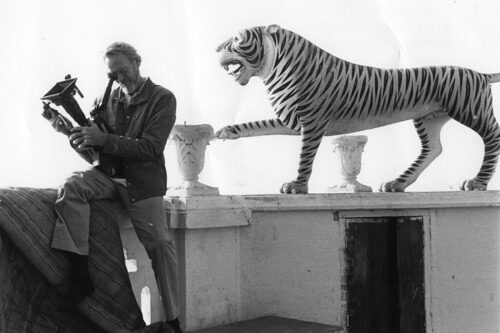
(A young John Marshall changing a film reel. I always thought he was cute.)

The theme for class this week was observational cinema. As sat and experienced my professors selections from anthropology heavyweights like David MacDougall, John Marshall and Jean Rouche, I found myself not only grateful that these men greatly understood the concept of a short film, but also thinking of how thankful I was for their contributions to the early years of the ethnographic documentary genre. These men proved that images on the screen could be as strong, if not stronger, than words in a book.

For over a century, anthropologists and social scientists have argued over which medium best represents an ethnographer's collected work: a book/written publication or a series of images. Now when I say I “experienced” their films, I'm referring to the fact that anthropological films cannot be, and were not meant to be, “watched.” Instead, they were created to provoke inquiry and inspire thought.

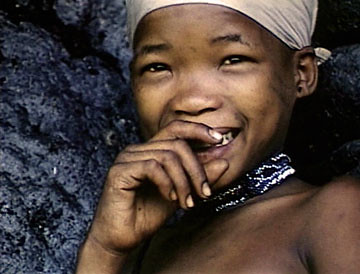
Marshall's “A Joking Relationship” is the perfect example of the ethnographic filmmakers equal, if not greater, obligation to maintain intellectual integrity than a normal ethnographer. The film visualized the kinship term for a relationship between two people, often of the opposite sex, who have a strong relationship rooted in playful mockery and sexual innuendo. For the Ju/'hoan bushmen of South Africa, this bond provides an emotional release that is stronger than most other familial relationships. Here we see N!ai and her great uncle-in-law engaging in a harmless flirtation as she jumps on his back while he threatens to cut off and eat her nipples.

At the end of the film, I noticed that it ends with a title card that reads “Directed by J. Marshall” (actually, as far as I can remember, this is on all his films on the Bushmen?). According to the Cambridge dictionary, a film director is “a person who is in charge of a film and tells the actors how to play their parts.” At what point does an ethnographer step away from being a data collector to being a data producer?


Marshall's editing and shooting techniques on "A Joking Relationship" redefine the role the ethnographer plays in creating a visual thesis.  If there was a film dictionary of ethnographic terms, I feel like this clip would fit perfectly under its title term.   He avoids the "fly-on-the-wall" feel by framing his subjects in extreme closeups, vignetting his observations by limiting what the viewer is privy too. At first, this method felt obtrusive and almost awkward as the camera panned across N!ai's exposed, undeveloped breasts and her great uncle's nether regions. Yet as the short carries on, I feel as though I'm reading a passage in a book. Marshall keeps a clear idea in his mind while he shoots with what he wants the viewer to see. He wants us to forget that we're about a hundred feet from the subjects, perched under a large shady tree in the Kahalari and keep us focused on nothing more than the intimacy, flirtation and casual sexual desire that carries on between the subjects.  Marshall proves that a visual ethnographer and writer are one and the same.  His pen is the camera lens: recording/writing a perfectly crafted anecdote on each frame/page, and then carefully compiling and editing it all together into a film/book.

If anything, I think the visualness of film brings to life something a great writer can never achieve. Descriptions become tangible as dances, rituals and forms of dress are exposed in their raw form. The fieldsite no longer remains an enigma; instead, the viewer can watch a film and be transported into subsaharan Africa and play the role of traveling ethnographer. Of course this isn't saying that all visual ethnographers are created equal not that every film is well constructed.   

Sunday, January 31, 2010

"Land Without Bread," Luis Buñon, 1932


For my next documentario de la semana (that's Spanish for “documentary of the week”), I have chosen the surrealist mokumentary “Las Hurdes: Tierra Sin Pan” (Luis Buñon, 1932). The tale of a town doomed by location and devastated by poverty and disease, “Tierra Sin Pan,” or “Land Without Bread” spends too much of its efforts trying to be comical to truly be considered a factual ethnographic film.

This historic Spanish town nestled deep in the steep mountainous region bordering Portugal is no stranger to bad press. It all started in 1663 when the townspeople were the main characters of a comedic play about a haunted town with no god and no morals. Buñon’s film came out of a 1927 ethnographic expedition to the area which was meant to cleanse the town of it’s bad reputation. Instead, Buñon and his crew took an opportunity for good and simply shamed the town in a new broader-reaching medium.

Much of the film took on a strictly ethnographic stance, offering a window into a world which many people had only previously read about. The images, like the town’s geography, offer a stark view of a people who have learned to live with nearly nothing. While the children are the only ones in town who can get their hands on some bread, they still have no access to a proper diet, adequate clothing or substantial health care. Sick people litter the streets as minor ailments sweep the town like the plague. We see buildings made of stone nestled so closely together that people are devoid of privacy.

To top it all off, Buñon also threw in some manipulated scenes as well – just for effect. When describing their diet, he explains that Los Hurdes only eat meat when a goat dies, for their milk is far too precious. Perfectly understandable, except that Buñon has a crew member shoot a goat and throw it off the side of a mountain for full effect. Another disturbing scene, when discussing their economy (bees), he emphasizes the peril of transporting the hives across the rugged terrain by sacrificing a donkey to an entire colony to be eaten alive.

But it’s not just the video clips that caused the Spanish government to ban this film (well, some of them played a hand) – it’s Buñon’s sarcastic narration that took jabs at a secluded society that is a day’s walk from any nearby civilization.

Set to classical music befitting of a horror film, Buñon’s straightforward and authoritative tone wants the viewer to take his words seriously. At first, I felt that I was watching a wartime newsreel. And then, within minutes, he takes his first jab at the small town, calling their main source of water a “wretched little stream.” How are we to even know that this even what it looks like at the height of it’s flow? His exaggerated sense of humor continued to grow as he often emphasized their lack of footwear as a sign of their extreme poverty. In another case, he insults one local woman, seen below, by telling the audience that her haggard looks are hardened not by old age, but that the lifestyle is so hard, even though obviously it is not the case.


After watching the film in horror over its concise 27 minutes, I couldn’t understand why Buñon would choose to put such a negative slant on his film. I can see how he was trying to make fun of the burgeoning genre of ethnographic film (the audio track was added to the film several years after its release, though he was always on hand at screenings to read his narration) by incorrectly narrating the video, but why did it have to be at the expense of Los Hurdes? Haven’t they been through enough?