Sunday, May 2, 2010
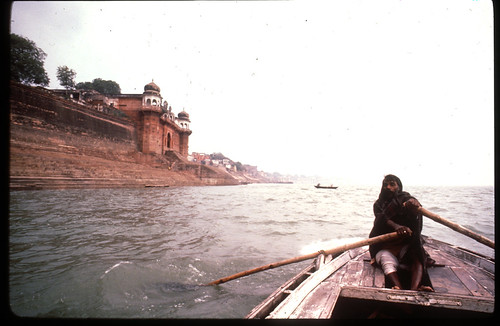
“As Long As There’s Breath,” Stephanie Spray (2009)
Friday, April 30, 2010
"Fake Fruit Factory," Chick Strand (1986)

Sunday, April 25, 2010
“Lunch Break,” Sharon Lockhart (2008)
Tuesday, April 6, 2010
“Demolition (Chaiqian),” J.P. Sniadecki, 2008
Sunday, March 28, 2010
“Deep Inside Clint Star,” Clint Alberta, 2000
Tuesday, March 16, 2010
“August: A Moment Before the Eruption,” Avi Mograbi, 2002
Sunday, March 7, 2010
“The Good Woman of Bangkok,” Dennis O’Rourke, 1992
Sunday, February 28, 2010
"Forest of Bliss," Robert Gardner, 1986
Sunday, February 14, 2010
"Them and Me," Stéphane Breton, 2001
Sunday, February 7, 2010
"A Joking Relationship," John Marshall, 1962
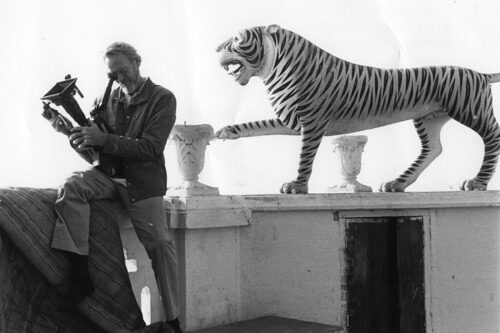
(A young John Marshall changing a film reel. I always thought he was cute.)
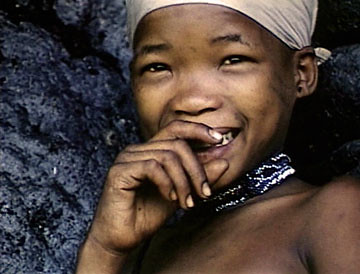
Marshall's editing and shooting techniques on "A Joking Relationship" redefine the role the ethnographer plays in creating a visual thesis. If there was a film dictionary of ethnographic terms, I feel like this clip would fit perfectly under its title term. He avoids the "fly-on-the-wall" feel by framing his subjects in extreme closeups, vignetting his observations by limiting what the viewer is privy too. At first, this method felt obtrusive and almost awkward as the camera panned across N!ai's exposed, undeveloped breasts and her great uncle's nether regions. Yet as the short carries on, I feel as though I'm reading a passage in a book. Marshall keeps a clear idea in his mind while he shoots with what he wants the viewer to see. He wants us to forget that we're about a hundred feet from the subjects, perched under a large shady tree in the Kahalari and keep us focused on nothing more than the intimacy, flirtation and casual sexual desire that carries on between the subjects. Marshall proves that a visual ethnographer and writer are one and the same. His pen is the camera lens: recording/writing a perfectly crafted anecdote on each frame/page, and then carefully compiling and editing it all together into a film/book.
Sunday, January 31, 2010
"Land Without Bread," Luis Buñon, 1932
For my next documentario de la semana (that's Spanish for “documentary of the week”), I have chosen the surrealist mokumentary “Las Hurdes: Tierra Sin Pan” (Luis Buñon, 1932). The tale of a town doomed by location and devastated by poverty and disease, “Tierra Sin Pan,” or “Land Without Bread” spends too much of its efforts trying to be comical to truly be considered a factual ethnographic film.
This historic Spanish town nestled deep in the steep mountainous region bordering Portugal is no stranger to bad press. It all started in 1663 when the townspeople were the main characters of a comedic play about a haunted town with no god and no morals. Buñon’s film came out of a 1927 ethnographic expedition to the area which was meant to cleanse the town of it’s bad reputation. Instead, Buñon and his crew took an opportunity for good and simply shamed the town in a new broader-reaching medium.
Much of the film took on a strictly ethnographic stance, offering a window into a world which many people had only previously read about. The images, like the town’s geography, offer a stark view of a people who have learned to live with nearly nothing. While the children are the only ones in town who can get their hands on some bread, they still have no access to a proper diet, adequate clothing or substantial health care. Sick people litter the streets as minor ailments sweep the town like the plague. We see buildings made of stone nestled so closely together that people are devoid of privacy.
To top it all off, Buñon also threw in some manipulated scenes as well – just for effect. When describing their diet, he explains that Los Hurdes only eat meat when a goat dies, for their milk is far too precious. Perfectly understandable, except that Buñon has a crew member shoot a goat and throw it off the side of a mountain for full effect. Another disturbing scene, when discussing their economy (bees), he emphasizes the peril of transporting the hives across the rugged terrain by sacrificing a donkey to an entire colony to be eaten alive.
But it’s not just the video clips that caused the Spanish government to ban this film (well, some of them played a hand) – it’s Buñon’s sarcastic narration that took jabs at a secluded society that is a day’s walk from any nearby civilization.
Set to classical music befitting of a horror film, Buñon’s straightforward and authoritative tone wants the viewer to take his words seriously. At first, I felt that I was watching a wartime newsreel. And then, within minutes, he takes his first jab at the small town, calling their main source of water a “wretched little stream.” How are we to even know that this even what it looks like at the height of it’s flow? His exaggerated sense of humor continued to grow as he often emphasized their lack of footwear as a sign of their extreme poverty. In another case, he insults one local woman, seen below, by telling the audience that her haggard looks are hardened not by old age, but that the lifestyle is so hard, even though obviously it is not the case.
After watching the film in horror over its concise 27 minutes, I couldn’t understand why Buñon would choose to put such a negative slant on his film. I can see how he was trying to make fun of the burgeoning genre of ethnographic film (the audio track was added to the film several years after its release, though he was always on hand at screenings to read his narration) by incorrectly narrating the video, but why did it have to be at the expense of Los Hurdes? Haven’t they been through enough?
Sunday, January 17, 2010
“Mother Dao, The Turtlelike,” Vincent Monnikendam, 1995
Hi, I'm Bianca, and welcome to my first blog for my USC Anthropology 575 Ethnographic Film & Media Seminar class. I'm going to allow this post to serve two-fold -- while the focus of my writing today is on the film we watched in class last Monday, I also want to warn my readers that my viewpoint doesn't come from a grad-level student working on their own ethnograhic film, for which this class was intended, but instead from that of a fresh-faced undergraduate who prefers working with still photography.
I am also going to admit up front that I did have to search online for more information about the content of the film. The movie starts with nothing but title cards before the viewer is shown footage of happy islanders set to a poem about a spiritual figure. There is no instructional voice-over, natural sound, or interviews. I have now discovered that the land we are studying for the next 58 minutes (about 28 minutes too long) is the Indonesian island of Nias, that the film is a collection of archival footage taken by the Dutch after the turn of the 20th century for propagandistic purposes, and that the spiritual figure from which the film derives its title is Mother Dao, a goddess who created the Earth from the dirt on her body and conceived of man through immaculate conception. In a disguised effort to reconstruct their original intent, the video clips are initially chronological but slowly begin to drag on as we continue to flip between scenes of jubilant Dutch colonizers and their adorable freckled children and the newfound poverty and despair of the Indonesian people. In a strictly observational mode, we watch the islanders live seemingly traditional lives, wearing traditional clothing, playing traditional music and performing traditional dances. Then everything takes a turn for the worse. We're briefly introduced to the colonizers before we begin to see the the lives of the natives completely deteriorate. Forests are burned for charcoal, oil derricks are installed, and the natives begin to wear Western attire as they shuttle off to factory jobs. For the remainder of the film, the images waver between instructional and grotesque. The lighter moments come as we laugh as the Dutch try to teach the Western language, music and religion, briefly forgetting that their traditional way of life is being destroyed. One harrowing image is that of a young boy, no older than a toddler, taking a puff from a rolled cigarette after suckling from his mother's breast.
Tuesday, January 20, 2009
2009!
I've taken my old blog from a media literacy class at my last college (I'm at USC now! Fight on!), "adultified" the layout and added some ads at the bottom (I'm at USC now! I'm broke!). But why those ads keep offering me free sex offender searches, I don't know.
Here's to a new year!
Sunday, November 18, 2007
Comm PSA
If anyone is doing a PSA on anti-smoking, there is a little contest open until December 17th for a 30 second PSA that could air on TV in California:
The grand prize is a chance to get your work on TV and/or on the web, which is still a great thing.
Tuesday, November 6, 2007
Indiana Jones and that crazy girl
I just watched my first Indiana Jones movie yesterday - Indiana Jones and the Temple of Doom. I wasn't the kind of child that enjoyed action flicks... the closest I ever ventured towards the genre was Help! (yeah, being randomly chased around the world is action, too!) and reruns of The Monkees.
All I can say about this movie is that I was terribly disappointed by it. I was already expecting little from it before the play button was pressed: not only was I watching a VHS from 1984, but the movie did come out in 1984, and visual effects were nothing like what we are treated to today. I've also never held George Lucas' work in high esteem, though he is the first to admit that his movies aren't known for having anywhere near engaging dialogue. The character development was extremely shallow.
What most frustrated me about this film was the female lead, Wilhelmina (eww) "Willie" Scott, played by Kate Capshaw. Why did it not surprise me to find that she is currently married to Steven Spielberg, and that this is the film set they met on? All I can say is that I was insulted from the first moment she spoke. She was whiny, bitchy and needy, not to mention incredibly easy. When she's not verbally degrading Dr.Jones ("I'd rather sleep with snakes than with you" - we all know how Indiana hates snakes), she's screaming her head off. Here's the trailer for Temple of Doom -- it gives you a glimpse of her acting prowess:
Sure, women in action films (that is, when they are not a lead character, as in Tomb Raider, or The Mummy) were meant to have roles that amplified the men's heroic actions. Willie truly has no purpose in the film; she is merely a budding actress trying to get her career started by working at an upscale bar (called "Obi-Wan".... get it? oh haha you're so cheeky Mr. Lucas!) in Shanghai who gets tagged along as a hostage by Dr.Jones, whom she nicknames "Indy." As she's taken along for the ride, she only gets worse. Somehow Indiana's clothes fit her perfectly enough that she can parade around in them for several days. At one point, while they are riding elephants through the jungles of India, she pour perfume on the animal... where that bottle came from, I HAVE NO CLUE! She snubs foreign cultures and screams at everything - bugs, snakes, Indy, high speed out-of-control vehicles, human sacrifices - that it totally amazed me that Indy would still want to have sex with her. Never once does she ever paint Indy with praise, with the exception of the last scene in which she smooches his amongst Indian villagers. What's worse is that Short Round, Dr.Jones' sidekick, is never thanked by her either.
It's no wonder that this is the biggest credit (aside from spawning 5 children with Spielberg) to her name. She was shredded in reviews, and the film was banned in India (lucky them). The following is an excerpt of the May 1984 review by Leonard Maltin, in which he gave the film 3 out of 10:
"The leading lady, played by Kate Capshaw, is a silly outmoded, dumbbell stereotype."
If aliens were to find this DVD and base upon it the nature of all human beings, they would find women to be stupid, shrill, powerless and useless (except as sex toys). I'll save for another blog what Indiana Jones teaches us about men.
Saturday, November 3, 2007
Are You Smarter Than a Fifth Grader - UPDATE!
Yay!
From theFutonCritic.com:
"On Thursday [11/01/07], two celebrity episodes of ARE YOU SMARTER THAN A 5TH GRADER aired back to back. The 8p telecast [Clay's show] of ARE YOU SMARTER THAN A 5TH GRADER posted its highest delivery among Adults 18-49 and Adults 18-34 so far this season and outperformed its prior season average by +13% among Adults 18-49, +21% among Adults 18-34 and +5% in Total Viewers."
too cool!
From Variety.com:
"Fox was deep in fourth place on the night with a pair of celebrity editions of "Are You Smarter Than a 5th Grader" that averaged a 2.5/6 in 18-49, 8.5 million viewers overall. Despite lagging the competition, Fox was the only network to improve upon its performance of a year ago, rising 40% above opening night of the November 2006 sweep (1.5 rating in 18-49) when it finished fifth, behind the CW."
Awesome!
Thursday, November 1, 2007
Check Me Out!
Yes, it's true! I was in the audience for an episode of "Are You Smarter Than a Fifth Grader?" with guest Clay Aiken, and it aired on Fox earlier tonight! I'll edit this post with screen caps as soon as I get them! I got TONS of airtime! yay! I'm a star, momma!
Whatever Happened to Halloween?
Last night a coworker of mine got me to start thinking... what has the media done to Halloween?
ABC7 ran a story in the afternoon featuring tips on how to keep your child safe while trick-or-treating, not only by making sure you keep a watchful eye on your child (unless you're Britney, you're doing this anyway) and by imposing curfews on convicted sex felons by not allowing them to celebrate the holiday at all.
I'm not saying we shouldn't keep pedophiles from our children, but do we need to be reminded of this? Isn't this a good time for a "no news is good news" mentality? Reporting a story like this is a double edged sword - you're telling the parents that their kids will be safe (yay!), but you're then enlightening them to the fact that there could be a sexual predator ready to steal your little ballerina or power ranger (not yay). This just sucks the unadulterated (no pun intended) fun out of Halloween!
And from razors in the apples... to lead in your teeth! Haven't people learned to just NOT buy anything from China any more? Gee, do you think the company perhaps withheld the recall information until Halloween day on purpose? People don't watch news on holidays (I know I sure don't) and store owners sure as heck didn't have enough time to take these items off the shelves... And it's a well known fact that recalls are voluntary and the products almost always remain in the stores. So now parents have to make sure their kids didn't get poisoned when they should already be making sure they didn't get any new cavities.
Why can't Halloween just be fun anymore? Just dress up! You're a regular person every other day of the year! Can't we let one day exist for a plain ol' good time?
And you know what else I learned? American tradition of Halloween was actually brought to the States by the Irish!